Artificial intelligence is changing the way the garment industry works. From design development and fabric sourcing to quality control, production planning, inventory management, and sustainability, AI is becoming an important part of modern textile manufacturing.
For fashion brands, private labels, retailers, and apparel buyers, this shift matters. The future of garment manufacturing will not only depend on skilled workers, sewing machines, and production capacity. It will also depend on smart data, automation, better planning, and faster decision-making.
AI does not replace craftsmanship. Instead, it helps manufacturers improve speed, reduce errors, control waste, and deliver more consistent products.
At Byon Textile, we believe the future of garment manufacturing will be built around a smart balance of people, machines, data, and responsible production.
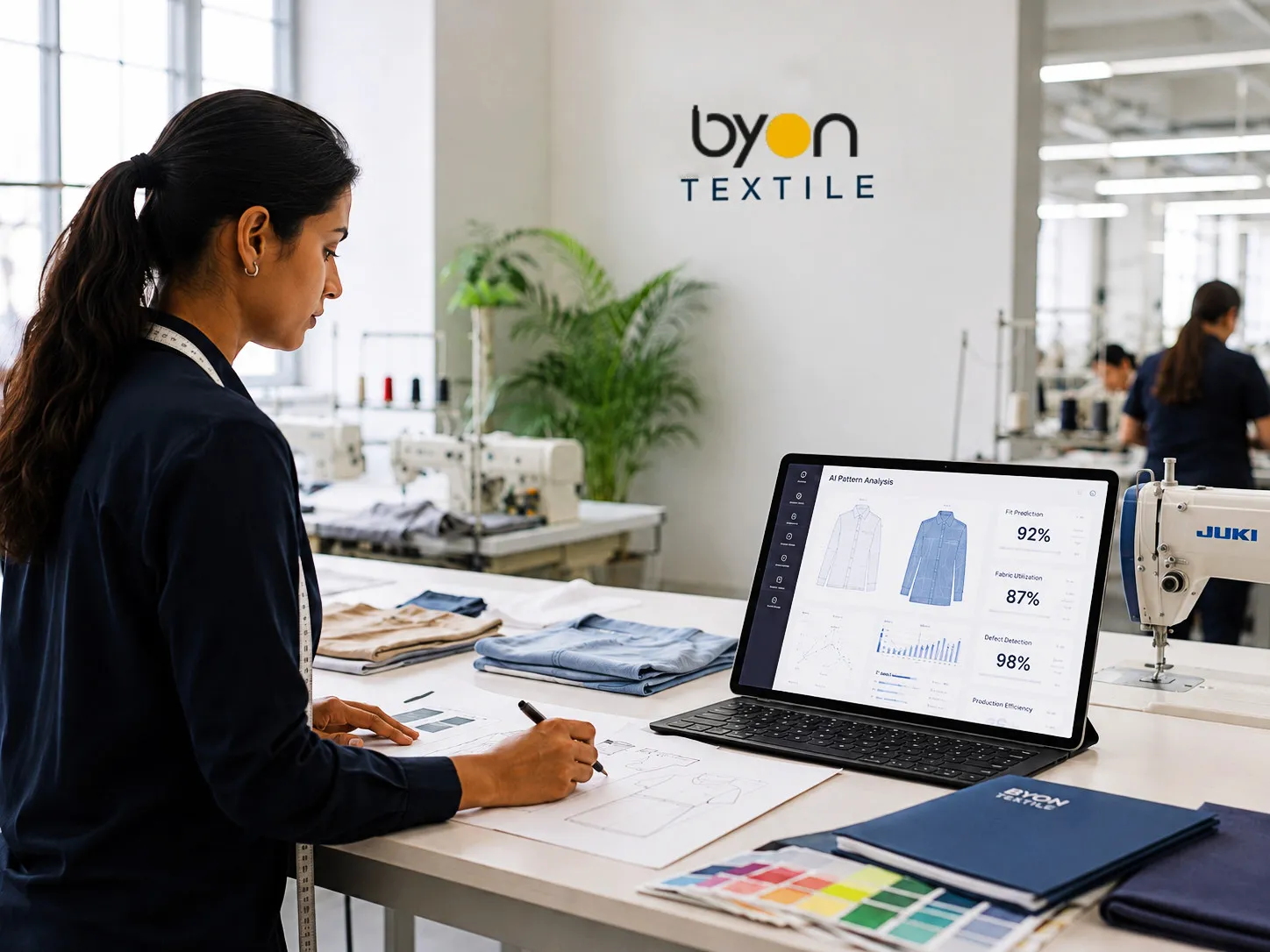
What Is AI in Garment Manufacturing?
AI in garment manufacturing refers to the use of intelligent systems that can analyze information, identify patterns, predict outcomes, and support better decisions across the production process.
In simple terms, AI helps factories and brands use data more effectively.
Instead of relying only on manual tracking, guesswork, or past experience, AI tools can help analyze production timelines, fabric usage, defect reports, machine performance, customer demand, and supply chain risks.
AI can support many areas of apparel manufacturing, including:
- Fashion trend analysis
- Product development
- Fabric sourcing
- Pattern optimization
- Marker planning
- Production scheduling
- Quality control
- Defect detection
- Inventory planning
- Predictive maintenance
- Demand forecasting
- Supply chain visibility
- Sustainability tracking
This makes AI useful for both manufacturers and fashion brands.
Why AI Matters for the Apparel Industry
The garment industry is fast-moving and highly competitive. Brands are expected to deliver quality products quickly, at the right price, with consistent sizing, reliable finishing, and responsible production practices.
At the same time, manufacturers face challenges such as:
- Rising material costs
- Shorter lead times
- Complex designs
- Smaller production runs
- Strict quality requirements
- Labor shortages in some markets
- Supply chain delays
- Waste reduction pressure
- Sustainability expectations
AI helps address these challenges by improving visibility and decision-making.
For example, AI can help a factory identify where production delays are happening, detect fabric defects earlier, optimize cutting layouts, or predict when a machine may need maintenance.
For fashion brands, AI can help forecast demand, reduce overproduction, and choose better product quantities before placing orders.
1. AI in Fashion Design and Trend Forecasting
One of the first areas where AI is making an impact is fashion design and trend forecasting.
Fashion brands can use AI tools to analyze customer behavior, online searches, social media trends, sales data, colors, silhouettes, and product performance. This helps brands understand what customers may want in upcoming seasons.
AI can support:
- Trend research
- Color direction
- Style inspiration
- Collection planning
- Product variation ideas
- Market demand analysis
- Competitor research
For example, a private label brand planning a hoodie collection can use AI-supported trend analysis to identify popular colors, fits, fabrics, and design details before starting sampling.
However, AI should not replace creative direction. A brand still needs human judgment, taste, identity, and market understanding. AI can suggest patterns, but designers decide what fits the brand.
2. AI in Product Development
Product development is one of the most important stages in garment manufacturing.
Before bulk production begins, brands and manufacturers must finalize the design, fabric, fit, size specifications, trims, branding, and construction details.
AI can help organize and speed up this process by supporting:
- Tech pack analysis
- Style comparison
- Measurement checks
- Fit prediction
- Fabric recommendations
- Cost estimation
- Sample feedback tracking
- Design variation planning
This can reduce confusion between buyers and manufacturers.
For example, if a brand submits a tech pack for a sweatshirt, AI-supported systems may help compare measurements, highlight missing details, or identify possible production issues before sampling begins.
This can save time and reduce repeated sample revisions.
To understand how product development fits into production, visit our manufacturing process page.
3. Smarter Fabric Sourcing With AI
Fabric selection affects nearly everything in a garment.
The wrong fabric can cause poor fit, shrinkage, color issues, weak durability, or customer dissatisfaction. The right fabric improves comfort, appearance, performance, and long-term product quality.
AI can help manufacturers and brands compare fabric options based on:
- Fabric composition
- GSM
- Shrinkage
- Colorfastness
- Stretch
- Texture
- Durability
- Supplier reliability
- Cost trends
- Availability
- Sustainability requirements
This is especially useful when brands are choosing between multiple fabric options.
For example:
- A hoodie may require fleece or French terry.
- Workwear may require strong cotton or poly-cotton blends.
- Denim may require specific weights, washes, and stretch levels.
- Bags may require canvas, polyester, denim, or coated fabrics.
AI can help organize fabric data and recommend better options based on performance and cost.
4. AI in Pattern Making and Fit Prediction
Fit is one of the biggest challenges in garment manufacturing.
A garment can have good fabric and strong stitching, but if the fit is wrong, the product may fail in the market.
AI can support pattern making by analyzing body measurements, size charts, garment specifications, and previous fit feedback. This can help improve size accuracy and reduce sampling errors.
AI-assisted fit prediction can help brands answer questions such as:
- Will this garment fit the target customer?
- Are the measurements consistent across sizes?
- Is the size grading logical?
- Will the fabric stretch affect the fit?
- Are there risks in sleeve length, shoulder width, or garment length?
This is especially useful for private label brands that want to build reliable sizing across multiple product categories.
5. AI-Powered Marker Planning and Cutting Optimization
Fabric waste is one of the biggest cost and sustainability challenges in garment manufacturing.
During cutting, patterns must be arranged on fabric in a way that uses material efficiently. Poor marker planning can waste fabric and increase production costs.
AI can support marker planning by finding better layouts for pattern pieces.
This can help:
- Reduce fabric waste
- Improve material utilization
- Lower production costs
- Improve cutting accuracy
- Increase consistency across sizes
- Support sustainable manufacturing
Even a small improvement in fabric usage can make a big difference in bulk production.
For manufacturers, this improves efficiency. For brands, it can help control cost and support sustainability goals.
Learn more about Byon Textile’s responsible production approach on our sustainability page.
6. AI in Production Planning
Garment manufacturing involves multiple connected stages.
A typical production workflow may include:
- Fabric sourcing
- Sampling
- Cutting
- Printing
- Embroidery
- Stitching
- Quality control
- Finishing
- Packing
- Shipment preparation
If one stage is delayed, the entire order can be affected.
AI can help production teams plan better by analyzing:
- Order quantity
- Available machines
- Worker allocation
- Fabric arrival dates
- Production capacity
- Current workload
- Delivery deadlines
- Previous production performance
- Possible bottlenecks
This helps factories schedule work more efficiently.
For example, if the embroidery section is overloaded, AI-supported planning tools can help identify the issue early and adjust the production schedule before it causes a delay.
For brands, better production planning means more reliable lead times and better communication.
7. AI in Sewing Line Efficiency
Sewing is one of the most labor-intensive parts of garment manufacturing.
Each product has different operations, such as joining panels, attaching sleeves, sewing collars, adding pockets, applying zippers, or attaching labels.
AI can help analyze sewing line performance by tracking:
- Operation time
- Worker efficiency
- Machine usage
- Defect frequency
- Bottleneck operations
- Production speed
- Rework rates
This information can help production managers balance sewing lines more effectively.
For example, if one operation is slowing down the entire line, the factory can add support, adjust workflow, or improve operator training.
This does not remove the need for skilled sewing operators. It helps managers support them better and improve production flow.
8. AI in Quality Control
Quality control is one of the strongest use cases for AI in garment manufacturing.
Traditional quality inspection depends heavily on manual checking. Skilled inspectors are still essential, but manual inspection can be slow and inconsistent, especially in high-volume production.
AI-powered visual inspection systems can help detect defects faster and more consistently.
AI can support inspection for:
- Fabric defects
- Stitching errors
- Print misalignment
- Embroidery defects
- Color variation
- Loose threads
- Surface marks
- Pattern irregularities
- Size inconsistencies
- Label placement errors
Computer vision systems can scan fabrics or garments and highlight possible issues for human inspectors to review.
This improves speed and helps reduce missed defects.
AI quality control is especially useful for:
- Denim
- Workwear
- Printed garments
- Embroidered apparel
- Sportswear
- Bags
- Uniforms
- Large-volume production
Better quality control protects both the manufacturer and the brand.
9. AI in Fabric Defect Detection
Fabric defects can create serious problems in garment production.
If defects are not caught early, they may appear in finished garments, causing rejection, rework, delays, or customer complaints.
AI-based fabric inspection can help identify problems such as:
- Holes
- Stains
- Weaving faults
- Color variation
- Lines
- Knots
- Creases
- Print defects
- Surface irregularities
This is important because fabric inspection is easier and more cost-effective before cutting and stitching.
Once defective fabric becomes part of a finished garment, the cost of correction becomes much higher.
AI can help detect these issues earlier, reducing waste and improving production quality.
10. AI in Printing and Embroidery
Printing and embroidery are essential for custom apparel, private label clothing, uniforms, bags, and branded merchandise.
AI can support printing and embroidery by improving:
- Artwork placement
- Logo positioning
- Color matching
- Stitch density analysis
- Embroidery file preparation
- Print alignment checks
- Defect detection after printing
For example, AI tools may help verify whether a logo is centered correctly on a hoodie or whether embroidery placement is consistent across all pieces.
This is valuable for brands because small branding errors can make products look unprofessional.
Byon Textile offers in-house printing and embroidery as part of our full manufacturing capabilities.
11. AI in Predictive Maintenance
Garment factories depend on many types of machines, including sewing machines, cutting equipment, embroidery machines, printing systems, finishing equipment, and compressors.
When a machine breaks down unexpectedly, production can slow down or stop.
AI can support predictive maintenance by analyzing machine performance and identifying early warning signs.
This may include:
- Machine usage time
- Temperature
- Vibration
- Speed
- Error frequency
- Maintenance history
- Production output
Instead of waiting for a machine to fail, factories can schedule maintenance earlier.
This helps reduce:
- Downtime
- Repair costs
- Production delays
- Quality problems
- Missed deadlines
For large-scale garment manufacturing, machine reliability is a major factor in production success.
12. AI in Inventory and Raw Material Management
Inventory management is another area where AI can help garment manufacturers.
Factories need to manage fabrics, trims, labels, threads, zippers, buttons, packaging, and finished goods.
Poor inventory planning can create delays, excess stock, or unnecessary costs.
AI can help track:
- Fabric availability
- Trim usage
- Reorder points
- Supplier lead times
- Slow-moving materials
- Stock shortages
- Material consumption patterns
- Production requirements
This allows manufacturers to plan purchases more accurately.
For brands, better inventory management means fewer delays caused by missing trims, labels, or packaging materials.
13. AI in Demand Forecasting
One of the biggest problems in fashion is producing too much or too little.
Overproduction creates waste, storage costs, and markdowns. Underproduction causes missed sales and customer frustration.
AI can help brands forecast demand by analyzing:
- Sales history
- Seasonal trends
- Customer behavior
- Product performance
- Regional preferences
- Search trends
- Market demand
- Social media signals
Better demand forecasting helps brands decide:
- How many units to produce
- Which colors to prioritize
- Which sizes to stock
- When to reorder
- Which products to discontinue
- Which styles to scale
This is useful for both established brands and new private label companies.
When brands understand demand better, manufacturers can plan production more efficiently.
14. AI in Supply Chain Visibility
The garment supply chain can be complex.
A single product may involve fabric suppliers, trim suppliers, printing teams, embroidery teams, stitching lines, quality inspectors, packaging teams, logistics providers, and buyers.
AI can improve supply chain visibility by helping track:
- Supplier performance
- Material delays
- Production progress
- Shipment timelines
- Cost changes
- Risk factors
- Order status
- Delivery estimates
This helps brands and manufacturers communicate better.
For example, if a fabric shipment is delayed, AI-supported systems may help adjust production schedules or recommend alternative materials earlier.
In modern garment manufacturing, visibility is a competitive advantage.
15. AI and Sustainable Garment Manufacturing
Sustainability is one of the most important reasons AI matters.
The textile industry faces growing pressure to reduce waste, use resources efficiently, and improve transparency.
AI can support sustainability by helping manufacturers:
- Reduce fabric waste
- Improve cutting efficiency
- Reduce overproduction
- Track energy usage
- Reduce rejected pieces
- Improve inventory planning
- Optimize packaging
- Monitor supplier performance
- Support responsible sourcing
AI can also help brands make better decisions before production begins.
For example, better demand forecasting can reduce overproduction. Better marker planning can reduce fabric waste. Better quality control can reduce rejected garments.
This makes AI useful not only for productivity but also for environmental responsibility.
16. AI in Cost Estimation and Quoting
Preparing accurate quotes is an important part of garment manufacturing.
Manufacturers must consider fabric cost, trims, printing, embroidery, stitching time, packaging, labor, overhead, and logistics.
AI can support cost estimation by analyzing past orders, current material prices, production complexity, and expected timelines.
This can help manufacturers provide more accurate and faster quotes.
For brands, this means better budgeting and fewer surprises.
AI-assisted costing can be especially useful for:
- Private label apparel
- Hoodies
- Denim
- Workwear
- Bags
- Uniforms
- Custom printed garments
However, final costing still needs human review because each product has unique requirements.
17. AI and Customization
Customization is becoming more important in fashion.
Brands want unique products, personalized details, custom labels, special trims, different fits, and small-batch collections.
AI can support customization by helping organize product variations.
For example, a brand may want the same hoodie in multiple colors, fabrics, labels, and print placements. AI can help manage these variations more efficiently during product development and production planning.
This makes it easier for manufacturers to support private label brands and custom apparel projects.
18. AI for Private Label Clothing Brands
Private label brands can benefit significantly from AI-supported manufacturing.
AI can help private label brands with:
- Faster product development
- Better design decisions
- Improved fabric selection
- More accurate sampling
- Better cost planning
- Lower defect rates
- Smarter inventory planning
- More reliable production timelines
- Improved sustainability
This is especially useful for startups and growing brands that need professional production support but may not have large internal teams.
If you are planning a private label apparel project, you can contact Byon Textile to share your requirements.
19. Will AI Replace Human Workers?
AI will change garment manufacturing, but it will not remove the need for skilled workers.
Garment production still depends on human expertise, especially in:
- Sewing
- Sampling
- Pattern adjustment
- Finishing
- Quality judgment
- Design development
- Problem-solving
- Buyer communication
- Production supervision
AI is best used as a support tool.
It can analyze data, detect patterns, and highlight problems. But humans still make final decisions, manage creativity, and ensure craftsmanship.
The future of garment manufacturing will be a collaboration between skilled teams and intelligent systems.
20. Challenges of Using AI in Garment Manufacturing
Although AI offers many benefits, it also comes with challenges.
Some common challenges include:
- High implementation cost
- Need for clean and accurate data
- Staff training requirements
- Integration with existing systems
- Limited access for smaller factories
- Dependence on reliable digital infrastructure
- Difficulty adapting AI to complex fabric types
- Need for human verification
Not every factory will adopt AI at the same speed.
Large manufacturers may implement advanced systems earlier, while smaller factories may start with simpler tools such as production tracking, digital quality reports, or AI-assisted design support.
The key is gradual improvement.
21. The Future of Smart Garment Factories
The future of garment manufacturing will likely involve more connected and intelligent factory systems.
A smart garment factory may connect:
- Design files
- Tech packs
- Fabric inventory
- Cutting plans
- Sewing line data
- Printing and embroidery details
- Quality inspection reports
- Packing records
- Shipment tracking
- Buyer communication
This creates a more transparent and efficient production environment.
Instead of managing everything manually, teams will have better access to real-time information.
This can help manufacturers reduce delays, improve quality, and provide better service to brands.
Byon Textile’s Perspective
At Byon Textile, we see AI as a tool that can strengthen the future of garment manufacturing.
Our focus remains on quality, reliability, sustainability, and scalable production. With complete cut-to-pack manufacturing, in-house printing and embroidery, 110 stitching machines, and a monthly production capacity of 20,000–30,000 units, we support brands looking for dependable apparel production.
As technology continues to evolve, manufacturers that combine skilled craftsmanship with smart systems will be better prepared for the future.
AI will not replace the foundation of garment manufacturing. It will improve it.
The future belongs to manufacturers who can combine experience, technology, communication, and responsible production.
Final Thoughts
AI is shaping the future of garment manufacturing by improving product development, fabric sourcing, production planning, quality control, machine maintenance, sustainability, and supply chain visibility.
For fashion brands, this means better decisions, more reliable production, and stronger product quality.
For manufacturers, AI creates opportunities to reduce waste, increase efficiency, and improve consistency at scale.
The future of textile manufacturing will not be purely manual or fully automated. It will be a smarter balance of people, machines, data, and responsible production.